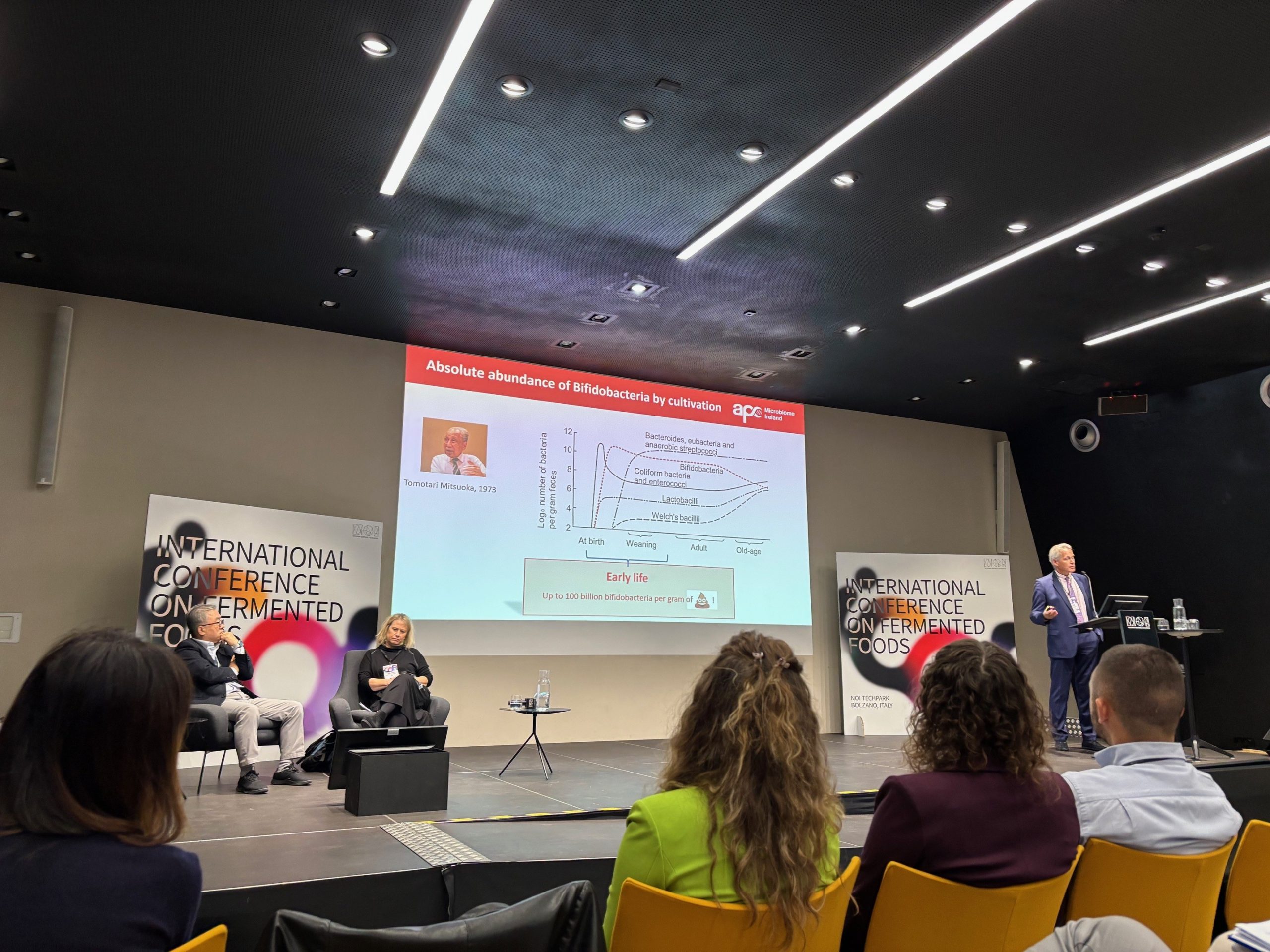
From October 27 to 30, 2025, Amerex took part in the International Conference on Fermented Foods, held at the NOI Techpark in Bolzano, Italy.
This international event brought together leading researchers, universities, and companies to discuss the latest advances in fermentation, biotechnology, and functional foods.
Representing Amerex, our Technical Director Alejandro Rodríguez attended the conference with the aim of learning first-hand about new fermentation trends applied to improving food safety and developing natural ingredients.
Throughout the sessions, innovations were presented related to the microbiota of fermented foods, the valorization of agri-food by-products through fermentation, and new biopreservation strategies — topics directly aligned with Amerex’s ongoing work in natural ferments for food preservation and quality.
Fermentation is consolidating itself as one of the most promising biotechnological tools for the future of the food sector. At Amerex, we have been committed to this field for years, developing protective cultures effective against pathogens such as Listeria monocytogenes and Salmonella, and exploring their potential as natural alternatives to traditional preservatives.
By participating in international forums like this, Amerex aims to remain at the forefront of research and innovation, continuing to provide the food industry with safe, cutting-edge biotechnological solutions.
Patricia Rodrigo is Head of Marketing & Product at Amerex. With a background in Biotechnology and a Master’s in Biotechnology Business Management, her work focuses on research and communication of natural alternatives to additives, conservation strategies, and pathogen control in various food groups for the industry.
https://amerexingredientes.com/wp-content/uploads/2025/11/Fermentacion_Italia-scaled.jpg19202560Patricia Rodrigohttps://amerexingredientes.com/wp-content/uploads/2017/11/Logo-web-amerex-madrid-2.pngPatricia Rodrigo2025-11-05 08:27:382025-11-05 09:36:30Amerex present at the International Conference on Fermented Foods in Italy
Welcome to our blog for another day! In this new post we will talk in more detail about the definition of probiotics, how they work, which are the most used strains and how they are used in the food industry.
By now, you’ve probably heard the term “probiotic” many times before, right? In recent years, research and development for the use of these microorganisms has increased significantly. It has increased not only for their application in health (where there are more and more studies demonstrating their benefits), but also within the food industry with the development of new products.
In the wake of COVID-19, the global probiotics market has been growing steadily, estimated to register a CAGR (Compound Annual Growth Rate) of 8.08% between the years 2022-2027. As we have mentioned in previous posts: INNOVATION IN THE FOOD INDUSTRY: NEW TECHNOLOGIES, the general concern for health and physical well-being, especially among young people, has led to an increase in demand for products that are healthy and safe and, if possible, help to strengthen our immune system. We see this trend reflected in all the functional foods and drinks being developed by major companies and the advertising of these products.
What are probiotics and what are their mechanisms of action?
Probiotics are living organisms that, once administered, remain active in the gut and can alter the host’s gut microbiota, generating benefits such as facilitating digestion and nutrient absorption and strengthening the immune system. In general terms, the World Health Organisation’s definition of probiotics is “live microorganisms that, when administered in sufficient quantities, provide a health benefit to the host”.
There are many foods or supplements that contain live micro-organisms, but in order to be considered a “probiotic” it needs to be a characterised strain that is scientifically proven to have a health benefit. Thus, a probiotic bacterium needs to be identified according to its specific identity (its genus and strain) and its health benefits.
As for the mechanisms of action of probiotics, these will be different depending on their genus and strain. In general terms, the following can be distinguished:
By competition: micro-organisms are able to establish themselves in mucous membranes and thus reproduce, preventing a pathogen from doing so.
By generation of antimicrobial compounds: thanks to the production of molecules such as lactic, acetic, propionic acid, etc. or bacteriocins, which are small peptides that inhibit the growth of similar bacteria or strains close to those that produce them.
By binding to the pathogen: thus preventing it from being able to attach to mucous membranes to reproduce.
By immunomodulation: mediating different components of innate, adaptive or acquired immunity.
How are probiotics identified by genus and strain?
As mentioned above, probiotics are identified according to their genus and strain and because of this they will be used for different applications.
A genus can include more than one species, which in turn includes different strains. For example, you may have heard of bifidobacteria, usually found in the large intestine, or lactobacilli, found in the small intestine, two of the most studied probiotics for supporting digestive health. Both are a genus of gram-positive bacteria of which there are different strains, each used for different purposes. Also important among probiotic organisms are yeasts, such as the genus Sacharomyces.
All these microorganisms have the status of QPS (Qualified Presumption of Safety) from the European Food Safety Authority (EFSA), as it is essential that an evaluation of the safety of the microorganisms used in supplements, feed additives, food additives, food enzymes, flavourings, etc. is carried out to ensure safety for consumers. There are also other references such as the Danish list from the Danish Ministry of Health and Veterinary Affairs, or the USDA GRAS list, where most commercial lactic acid bacteria are considered safe.
What foods are rich in probiotics and what are the applications in food?
As we have seen, the definition of probiotic is closely related to health and it may seem that probiotics are only used as “food supplements”, but the scope of application of probiotic bacteria is very wide and we find a multitude of foods containing natural probiotics such as: sauerkraut, natural yoghurt, kombucha, Kimchi, kefir or pickles.
Thus, the global probiotics market could be segmented on the basis of product type as follows:
– Probiotic foods
– Probiotic drinks
– Dietary supplements
– Animal feed
If we go further, knowing the mechanisms of action of probiotics described in section 1, are there more applications of probiotics than just health benefits? The answer is clearly yes!
People in general relate the main activity of probiotics exclusively to health. In other cases, more informed consumers consume probiotic foods, such as those mentioned above, to support their digestive health and improve their immune system. But what many people do not know is that these same probiotic bacteria can be used within the food industry as natural preservatives.
If the necessary quantities of probiotic bacteria are inoculated into a food, depending on the genus and strain and based on the mechanisms described above, protection against pathogenic organisms such as Listeria, E.coli or Salmonella, three examples of the many pathogens and contaminating microorganisms in food, can be generated. Thanks to this, a new research front is emerging that encompasses the general concern for health and physical well-being together with a healthy diet free of chemical additives.
Is there more information on natural conservation?
At Amerex we are experts in products aimed at preserving the final food by means of natural protection mechanisms. We have more than 40 years of experience selling ripening starters to carry out the maturation of food, which is used to ensure its preservation.
For years, we have also had a wide range of products, such as the Biamex® range, to extend the shelf life of foodstuffs. These are natural preservatives with a biotechnological base, being protective ferments that have a direct action against pathogenic microorganisms.
If you want to know more about probiotic foods or natural preservation thanks to the use of different probiotic strains, do not hesitate to contact us!
Amerex’s Technical Director, Alejandro Rodríguez, holds a degree in Biology and a master’s degree in biotechnology applied to food preservation. With a solid track record of over 10 years developing natural solutions, he leads projects focused on protective fermentation and innovative technologies to ensure food safety and quality.
https://amerexingredientes.com/wp-content/uploads/2023/03/Miniatura-que-son-los-probioticos.png400400Alejandro Rodríguezhttps://amerexingredientes.com/wp-content/uploads/2017/11/Logo-web-amerex-madrid-2.pngAlejandro Rodríguez2023-04-05 10:21:252025-05-19 10:58:13WHAT ARE PROBIOTICS?
To offer the best experiences, we use technologies such as cookies to store and/or access device information. Consent to these technologies will allow us to process data such as browsing behavior or unique IDs on this site. Failure to consent, or withdrawal of consent, may adversely affect certain features and functions.
Funcional
Always active
El almacenamiento o acceso técnico es estrictamente necesario para el propósito legítimo de permitir el uso de un servicio específico explícitamente solicitado por el abonado o usuario, o con el único propósito de llevar a cabo la transmisión de una comunicación a través de una red de comunicaciones electrónicas.
Preferences
El almacenamiento o acceso técnico es necesario para la finalidad legítima de almacenar preferencias no solicitadas por el abonado o usuario.
Statistics
El almacenamiento o acceso técnico que es utilizado exclusivamente con fines estadísticos.El almacenamiento o acceso técnico que se utiliza exclusivamente con fines estadísticos anónimos. Sin un requerimiento, el cumplimiento voluntario por parte de tu proveedor de servicios de Internet, o los registros adicionales de un tercero, la información almacenada o recuperada sólo para este propósito no se puede utilizar para identificarte.
Marketing
El almacenamiento o acceso técnico es necesario para crear perfiles de usuario para enviar publicidad, o para rastrear al usuario en una web o en varias web con fines de marketing similares.