PRESERVATIVES AGAINST LISTERIA IN SALMON
Smoked salmon is one of the most valued products by consumers around the world. However, it also represents one of the biggest challenges for manufacturers due to its high susceptibility to contamination by Listeria monocytogenes, the bacterium responsible for listeriosis.
In recent years, there have been many cases in which well-known brands have had to withdraw their products from the market following outbreaks of this pathogen, triggering food scares that damage brand image and generate considerable economic impact.
How does the pathogen Listeria affect the salmon market?
Listeria monocytogenes finds in smoked salmon and other seafood products an ideal environment for its development: ready-to-eat food, without further heat treatment, with a high water activity and a pH that allows bacterial growth. Moreover, listeriosis is a serious infection with a high rate of hospitalisation and mortality, especially dangerous for pregnant women, immunocompromised and elderly people.
Unlike other pathogens, Listeria is able to grow even at refrigeration temperatures, making it a difficult threat to eradicate in products such as cured, marinated or cold-smoked salmon. Studies and data from official agencies confirm that fish is, together with ready-to-eat meat products, one of the food groups with the highest number of listeriosis outbreaks in Europe.
What are the new rules on Listeria in ready-to-eat foods such as smoked salmon?
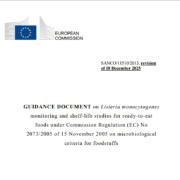
Aware of the risk, the European Commission has updated the microbiological regulation with the publication of Regulation (EU) 2024/2895, which amends Regulation (EC) 2073/2005 with regard to Listeria monocytogenes. From 1 July 2026, the requirements for ready-to-eat foods that may support the growth of Listeria – such as smoked salmon – will be tightened:
- Total freedom from Listeria monocytogenes will be required for the entire shelf life of the product.
- This requirement concerns all ready-to-eat products that support the growth of Listeria: with a pH > 4.4 or a water activity (aw) > 0.92, or when both parameters together exceed pH > 5 and aw > 0.94.
- As an exception, a limit of up to 100 cfu/g is allowed if the manufacturer can demonstrate, through studies and tests (such as challenge tests), that the level of the pathogen will not exceed this threshold over the shelf life of the food.
This puts added pressure on food businesses to adopt more effective prevention and control strategies to ensure food safety without compromising the organoleptic quality of the product.
What preservatives does Amerex offer that are effective against Listeria monocytogenes in salmon?
At Amerex we are aware of the challenge of controlling Listeria in foods such as smoked salmon. That’s why we have developed natural preservation solutions that act as an effective barrier to the growth of Listeria monocytogenes, without adversely affecting the taste, flavour or texture of the final product.
Our ingredients, based on protective fermentation technologies, have been validated through challenge tests and predictive microbiology studies in multiple food matrices, including seafood. In particular, our specialist against Listeria, Fermitrat Export, in most cases not only shows a bacteriostatic effect (growth inhibition) but also a listericidal action, with negative growth potential of the pathogen.
Thanks to this evidence, our products enable manufacturers to:
- Comply with new regulatory requirements.
- Extend product shelf life without compromising safety.
- Maintain a clean label with natural and sustainable solutions.
At Amerex, we help the food industry protect their products, their brand and the consumer with effective solutions adapted to new market demands. If you work with products such as smoked salmon, contact us: we can help you implement a safe, innovative and natural preservation strategy.
Would you like more information on these products? Contact us for a closer and personalised advice through:
- You can write us an email to: imasd@amerexingredientes.com
- Call us on: +34 91 845 42 14
- Fill in the form below


Patricia Rodrigo is Head of Marketing & Product at Amerex. With a background in Biotechnology and a Master’s in Biotechnology Business Management, her work focuses on research and communication of natural alternatives to additives, conservation strategies, and pathogen control in various food groups for the industry.