Case study of protective ferment in mayo salad: safety and flavour without chemical additives
In a context where consumers increasingly value fresh, natural foods with clean labels, ensuring microbiological safety without compromising sensory quality is a major challenge. At Amerex, we have numerous case studies in different processed foods that help guarantee both safety and organoleptic quality.
Below, we present a practical case applied to ensaladilla rusa (Mayo salad), a very typical dish in Spain, which applied to any food coated with a sauce (such as potatoes with mayo).
In this case, we used one of our natural preservatives, Biamex-Aroma-SP, a natural solution that has proven effective against gram-positive bacteria such as the pathogen Listeria monocytogenes, as well as in controlling spoilage heterofermentative bacteria.
What is mayo salad and how is it consumed in Spain?
Mayo salad (ensaladilla rusa) is one of the most consumed ready-to-eat dishes in Spain, especially in foodservice and hospitality. Its basic ingredients, for those unfamiliar, are boiled potato, carrot, peas, and egg, covered with mayo—making it a highly appreciated recipe for its traditional flavour and versatility. Today, there are many variations of the original recipe, such as seafood mayo salad.
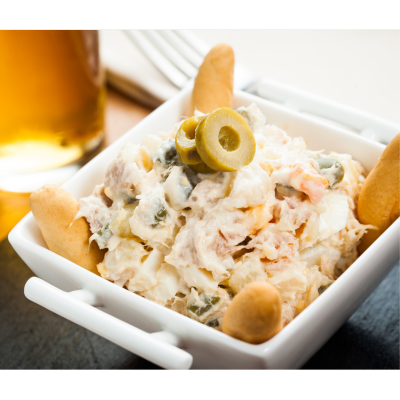
It is commonly consume as a tapa, appetizer, or side dish. Its main consumption occurs in summer, since it is a ready-to-eat dish that does not need heating. Traditionally, it was homemade by boiling the vegetables, chopping them, and mixing them with mayonnaise and tuna. Nowadays, with the rise of fifth-range products, it can be found both in restaurants (as homemade preparations or ready-to-eat versions) and in the supermarket’s prepared food aisle.
What are the physico-chemical characteristics of mayo salad?
To continue, it is necessary to understand the physico-chemical characteristics of Mayo salad, as these determine potential microbiological and organoleptic issues.
From a microbiological perspective, Mayo salad (and similar ready meals) presents high water activity (aw > 0.97) and a pH close to neutrality. Combined with its consumption without final heat treatment moreover, its composition rich in cooked ingredients and plant/animal proteins, it is particularly susceptible to the growth of pathogenic microorganisms such as Listeria monocytogenes.
Listeria is capable of growing at refrigeration temperatures and resisting adverse conditions, so its control requires strategies beyond good hygiene practices. Additionally, as mentioned above, Mayo salad and similar dishes are typical in summer, when high temperatures make it easy for the cold chain to be broken.
What regulation applies to ready-to-eat foods like mayo salad, and what chemical additives are currently used?
As a ready-to-eat product, Mayo salad is subject to the microbiological criteria of Regulation (EC) 2073/2005, updated by Regulation (EU) 2024/2895, which establishes the absence of Listeria monocytogenes throughout the product’s shelf life, except when technical justification based on challenge tests allows the limit of 100 cfu/g.
Traditionally, to control microbiological risk, manufacturers have used preservatives such as sorbates, benzoates, acidulants, or thermal treatments. The issue with these chemical additives is that they lower pH and consequently alter the organoleptic properties of the product. They affect flavour, texture, and consumer perception, giving the final product a “more artificial” appearance. For this reason, the industry is seeking natural solutions that maintain safety without compromising sensory quality.
With this context, we detail the following case study.
Practical case using Amerex protective ferments to improve the microbiological safety of Russian salad without additives that alter sensory quality
We worked with a Mayo salad from a manufacturer aiming for a homemade and less industrial sensory profile. To achieve this, chemical additives were removed, which otherwise gave the mayonnaise a more liquid and yellowish appearance. The challenge that followed was to guarantee microbiological safety and ensure compliance with the legal requirements described above.
Therefore, Amerex’s goal was to offer a clean label solution effective against pathogens. We carried out a challenge test using one of our protective ferments, Biamex-Aroma-SP (2 g/kg), incorporated into the mayonnaise-based sauce applied to the vegetable matrix.
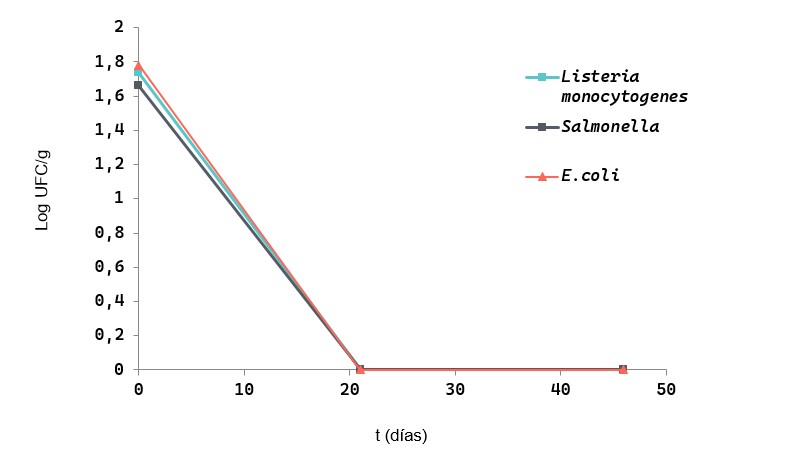
Samples were inoculated with Listeria, Salmonella, and E. coli to evaluate the effectiveness of the natural preservative over time under refrigeration. Additionally, a sensory tasting was conducted to assess changes in flavour, texture, and aroma.
Results obtained without chemical additives: microbiological safety and improved organoleptic profile
Microbiological results:
The addition of Biamex-Aroma-SP showed clear inhibition of Listeria monocytogenes growth in treated samples, with either listericidal or bacteriostatic behavior maintained throughout shelf life. A strong reduction of Salmonella and E. coli was also observed, confirming its protective effect.
Organoleptic results:
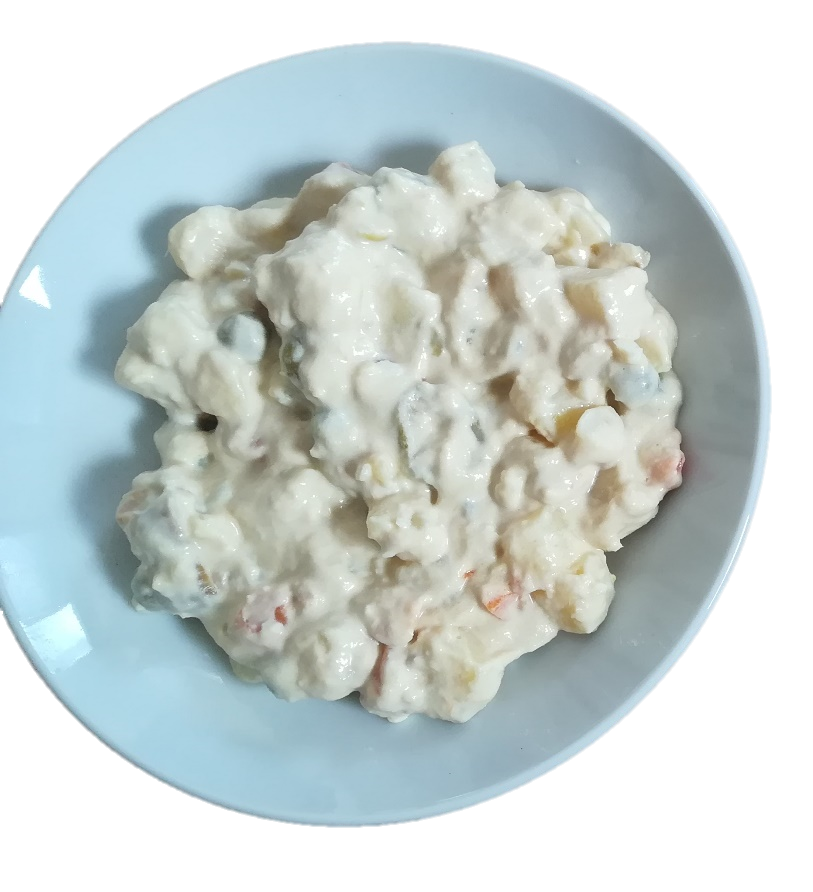
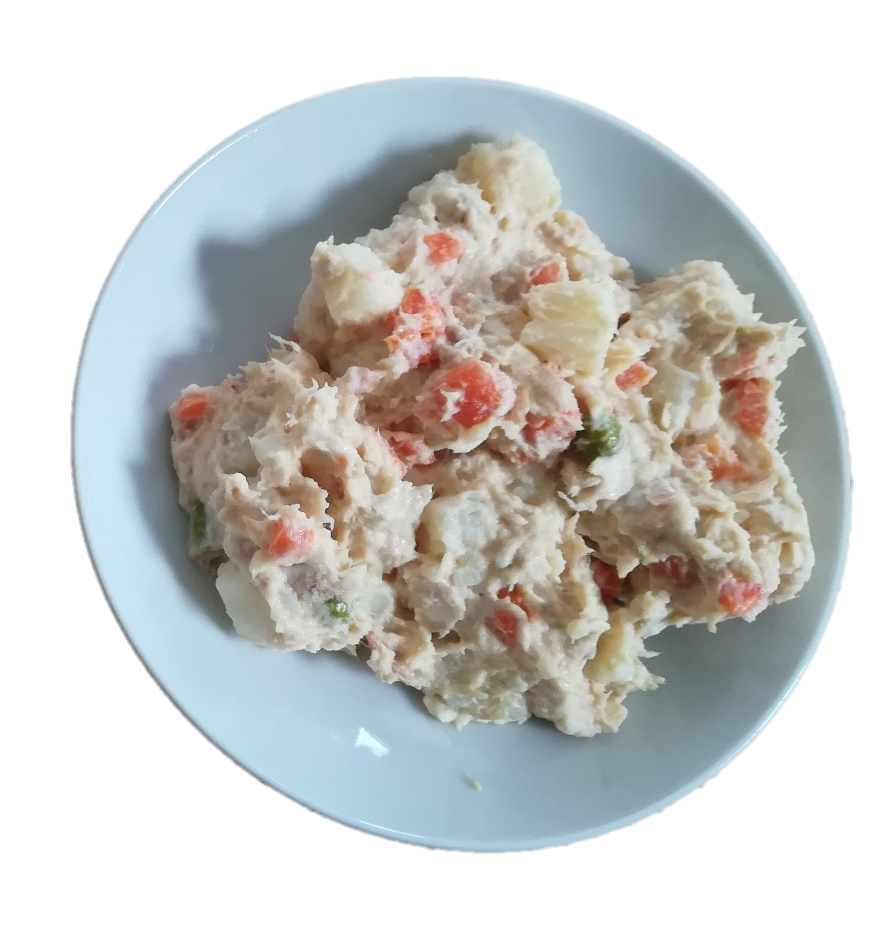
The mayo salad treated with Biamex-Aroma-SP was rated as more homemade and traditional compared to the version without protection. It was described as having a balanced flavor, without excessive acidic notes, and a more pleasant texture, as the formulation allowed for reduced use of acidulants and chemical preservatives. Furthermore, the need for aggressive heat treatments was reduced.
Chemical additive o vs Amerex preservative
Conclusion: a clean label solution for refrigerated ready-to-eat products
This case study demonstrates that Biamex-Aroma-SP is an effective and natural solution to improve microbiological safety and sensory quality in ready-to-eat products such as mayo salad. Its use allows:
- Effective inhibition of Listeria monocytogenes and other pathogens.
- Compliance with new European regulatory requirements.
- Improvement of the product’s sensory profile.
- Reduction or elimination of artificial preservatives and acidulants.
At Amerex, we work to provide innovative solutions tailored to the real needs of the food industry. If you are developing or reformulating refrigerated ready-to-eat products such as Russian salad, consult us and discover how we can help you ensure safety, flavor, and naturalness.
📩 Contact us for more information and personalized advice:
- Email: imasd@amerexingredientes.com
- Phone: +34 91 845 42 14
- Fill out the form below


Amerex’s Technical Director, Alejandro Rodríguez, holds a degree in Biology and a master’s degree in biotechnology applied to food preservation. With a solid track record of over 10 years developing natural solutions, he leads projects focused on protective fermentation and innovative technologies to ensure food safety and quality.