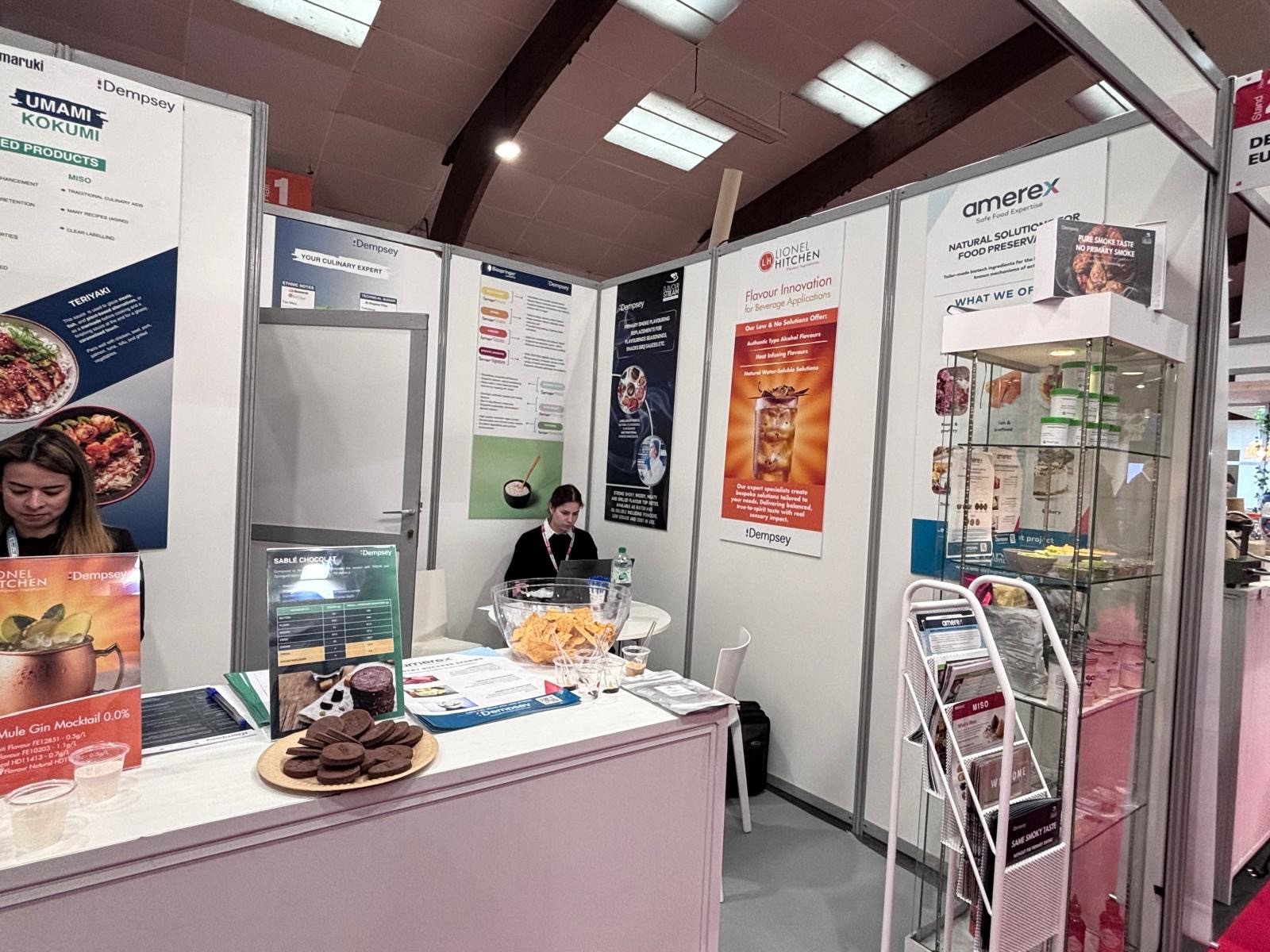
Amerex recently took part in CFIA Rennes, the leading European trade fair for the food processing industry, held annually in Rennes (France). The event brings together more than 2,000 exhibitors and thousands of professionals from the agri-food sector to discover the latest innovations in ingredients, processing, packaging and food safety.
Amerex was represented by Alejandro Rodríguez, Technical Director, and Zoe, Sales Technician, who joined the event at the stand of our partner Dempsey Europe to present several real-world applications of our fermentation- and biotechnology-based solutions.
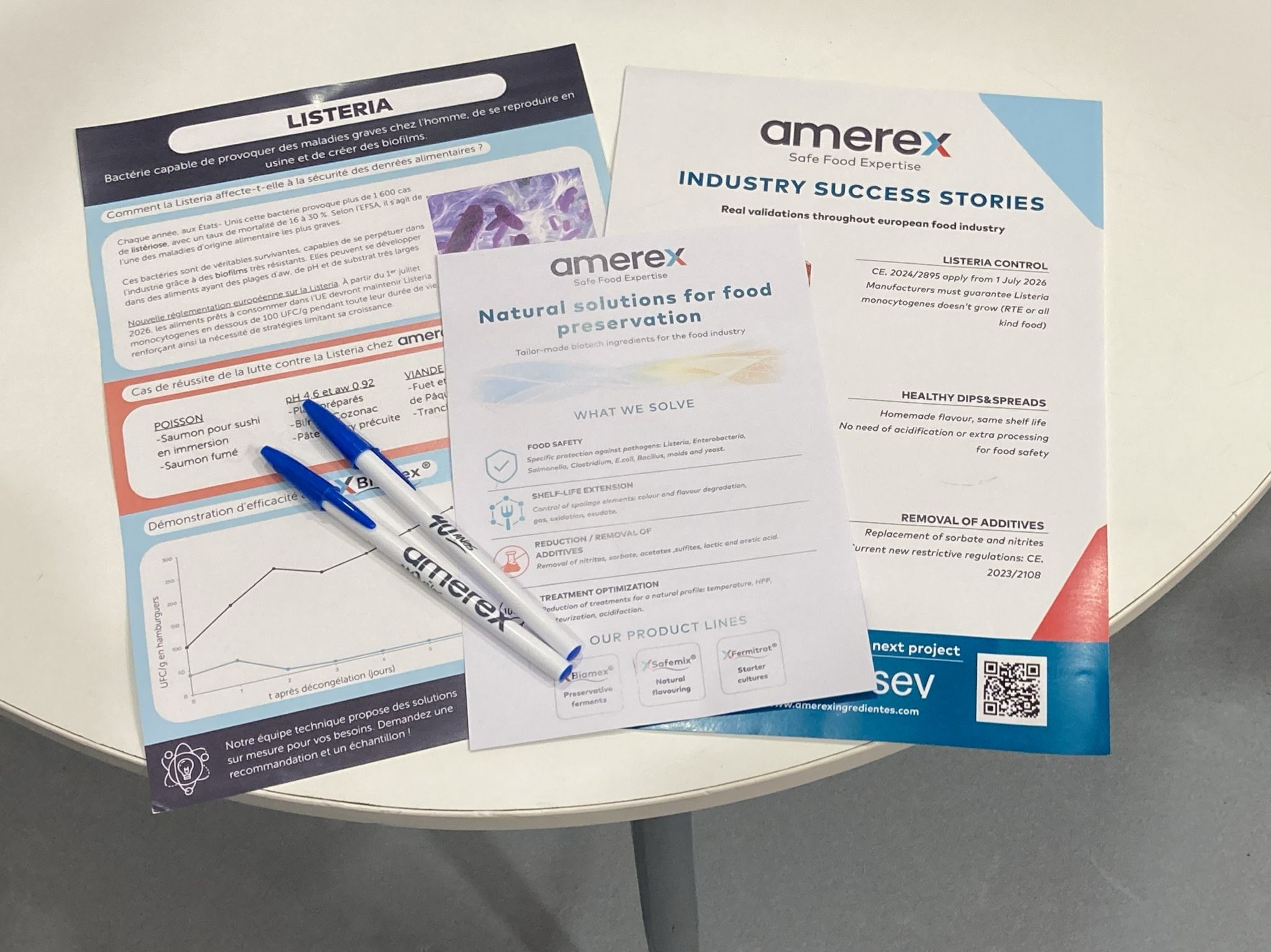
During the exhibition, the team presented successful case studies in the dip & spread category, demonstrating how Amerex ferments can improve microbiological stability, extend shelf life and maintain the sensory quality of these products, responding to the growing demand for natural and clean-label preservation solutions.
The team also addressed some of the most pressing challenges currently facing the food industry, including the control of Listeria monocytogenes in ready-to-eat foods and strategies for nitrite reduction, topics that are particularly relevant in light of recent regulatory developments in Europe.
Participating in CFIA Rennes enabled Amerex to exchange knowledge with food manufacturers from across Europe, gain insights into emerging technological trends and continue driving innovative solutions that help the food industry develop safer, more natural products aligned with evolving regulatory and consumer expectations.
If you’d like to find out more about our preservatives, please don’t hesitate to get in touch!
Patricia Rodrigo is Head of Marketing & Product at Amerex. With a background in Biotechnology and a Master’s in Biotechnology Business Management, her work focuses on research and communication of natural alternatives to additives, conservation strategies, and pathogen control in various food groups for the industry.
https://amerexingredientes.com/wp-content/uploads/2026/03/CFIA1.jpg15342048Patricia Rodrigohttps://amerexingredientes.com/wp-content/uploads/2017/11/Logo-web-amerex-madrid-2.pngPatricia Rodrigo2026-03-13 13:38:242026-04-09 08:55:02Amerex showcases its natural preservation solutions at CFIA
¡Bienvenidos nuestra última entrada del blog! El 2025 ya está aquí y con él llegan avances y tendencias que prometen revolucionar el sector alimentario. Desde soluciones innovadoras en conservación natural hasta alternativas sostenibles a los aditivos tradicionales, este año se perfila como un punto de inflexión hacia un futuro más limpio, sostenible y orientado al consumidor.
En este último blog vamos a estudiar las principales tendencias que marcarán la industria alimentaria en 2025 y cómo estas impactan en el desarrollo de productos y tecnologías.
1. Etiquetado limpio y conservación natural: la prioridad de los consumidores
Desde hace varios años, la prioridad de los consumidores ha sido el etiquetado limpio, libre de aditivos y priorizando que no estén altamente procesados. El deseo por alimentos naturales y sin “ingredientes sospechosos” es una tendencia que sigue en aumento. Los consumidores exigen soluciones que prolonguen la vida útil de los productos sin comprometer la transparencia o la calidad.
Conservación natural: Ingredientes como extractos botánicos, fermentos y cultivos protectores están reemplazando a los conservantes artificiales.
Aumento del clean label: Los consumidores buscan etiquetas más simples, entendibles y libres de “números E”.
Por nuestra parte, llevamos años ayudando a empresas a conservar sus productos de forma segura y clean label gracias a nuestras soluciones microbiológicas basadas en fermentos naturales.
2. Tecnologías avanzadas para una conservación sostenible
La innovación tecnológica juega un papel crucial en la conservación de alimentos, no solo se busca innovación en cuanto a ingredientes sino a otro tipo de tecnologías, como por ejemplo:
Envases activos: Diseñados para interactuar con los alimentos, absorben oxígeno o liberan antioxidantes naturales, alargando su vida útil.
Tecnologías de barrera: Revestimientos comestibles basados en algas o quitosano que prolongan la vida útil sin añadir conservantes.
Procesos físicos: Como el uso de pulsos eléctricos o luz ultravioleta, que eliminan microorganismos sin necesidad de aditivos químicos.
3. Alternativas a aditivos: se busca lo natural
El mercado sigue buscando alternativas a los aditivos tradicionales, marcando un cambio hacia soluciones más sostenibles y menos procesadas. En esta búsqueda, existen dos ejemplos como son, las proteínas funcionales, usadas para reemplazar estabilizantes en productos lácteos o carnes; y los ya conocidos extractos de hierbas y especias que actúan como conservantes antioxidantes y antimicrobianos.
En Amerex sin embargo, desarrollamos de manera personalizada alternativas clean label que cumplen con las normativas más exigentes y las demandas de los consumidores basadas en microbiología.
4. Fermentación y microbiología: los protagonistas del año
La biotecnología basada en fermentación se posiciona como la herramienta clave para soluciones naturales en conservación.
Fermentos protectores: Cultivos específicos que inhiben patógenos y prolongan la vida útil sin alterar el sabor ni la textura.
Probióticos y postbióticos: Aumentan la funcionalidad de los alimentos, haciendo que sean más saludables y duraderos.
Expertise de Amerex: Con más de 40 años de experiencia, ofrecemos soluciones a medida para la conservación natural y sostenible basada en fermentación protectora. Si quieres saber saber más no dudes en contactarnos.
El 2025 trae consigo grandes oportunidades para quienes apuesten por la innovación y las soluciones naturales. En Amerex, seguimos comprometidos con liderar el cambio, ofreciendo alternativas a los aditivos tradicionales y desarrollando soluciones clean label que marcan la diferencia.
¡Si estás buscando implementar tendencias en conservación natural o necesitas alternativas personalizadas para tus productos, no dudes en contactarnos!
• Escríbenos un correo a: imasd@amerexingredientes.com
• Llámanos al: 91 845 42 14
• Rellena el formulario a continuación
Nuria Lázaro is the R&D and Quality Manager for Amerex’s technical team. She holds a degree in Biology and a master’s degree in Biotechnology. She brings her experience in food preservation and safety, specializing in legislation and the development of new preservatives and antioxidants.
https://amerexingredientes.com/wp-content/uploads/2025/01/Agricultor-cuidando-su-cosecha-miniatura.png400400Nuria Lázarohttps://amerexingredientes.com/wp-content/uploads/2017/11/Logo-web-amerex-madrid-2.pngNuria Lázaro2024-12-23 11:34:582025-05-19 10:40:36Tendencias en conservación natural del sector alimentario en 2025
Acetic acid and its salts are chemical compounds that have been widely used in various industries due to their preservative and antimicrobial properties. However, their use has also been the subject of debate due to their effects on health and the environment, and consumer trends point to the use of more natural and clean label alternatives, and fewer chemical preservatives and additives. In this blog we will explore what acetic acid is, its role in the industry and promising alternatives for improving its efficacy against spoilage microorganisms.
What is acetic acid?
Acetic acid is an organic acid commonly found in vinegar and other natural sources, and can be synthesized chemically as well. It has been used for centuries for food preservation and as an antimicrobial agent due to its ability to inhibit the growth of microorganisms. In addition to this general microbiological control, there is a special efficacy against enterobacteria, a group of Gram-negative bacteria that can be found on various surfaces and foods. These types of bacteria are among the most complicated for the food industry, since some are pathogenic, such as Salmonella and E. coli, and can cause diseases of special relevance to humans derived from consuming food that has developed them. Even with this specific activity, acetic acid usually requires synergies with other preservatives of different origins to control its appearance.
Acetic acid is so widely used in the industry that it is an additive with E number, E-260, and all its salts, such as sodium diacetate, also, the latter being the additive with E number E-262ii.
Does the use of acetic acid affect the food organoleptically?
The application of acetic acid or its salts not only has an impact on food preservation, but also has a significant effect on the organoleptic characteristics of food products.
Acetic acid is responsible for providing a sour and acid taste, which when used in high concentrations or in foods with very neutral organoleptics, can be accentuated against the other flavors present in the food. Similarly with aroma, in products where aroma is not a desired attribute or where the integrity of the natural aroma of the ingredients is to be maintained, excessive use of acetic acid can have a negative impact.
It can also have an effect on food texture. In products that seek to preserve their original texture or require a certain firmness, excessive use may denature proteins and negatively affect the desired texture.
For this reason, acetic acid is used together with other preservatives to achieve efficacy and to avoid over-flavoring. Among these synergistic strategies we find protective fermentation: the use of protective ferments in a food at standard doses plays no role with respect to taste, texture or aroma. Therefore, it is common for the industry to use the synergy between acetic acid and this type of ferments to achieve a preservative function while not influencing the organoleptic characteristics of any final food in which it is needed.
What other synergistic mechanisms to acetic acid are alternatives for the industry?
The extensive use of acetic acid and its salts may raise some challenges and concerns, such as the development of antimicrobial resistance in enterobacteria and other bacteria present in foods, or that its excessive use may alter the desired sensory profile in certain products. As we become more aware of their limitations, the food industry has sought safer and more sustainable alternatives for the control of enterobacteria. Some of these alternatives include natural antimicrobial compounds such as plant extracts and essential oils; physical methods such as the application of high temperatures and high pressure treatments; or innovations in packaging through the development of intelligent and active packaging; in addition, a new line of research is the use of bacteriophages.
But undoubtedly the best synergistic mechanism to the additives in general, and to acetic acid or its salts in particular, is the use of protective fermentation solutions which in addition to having a strong antimicrobial activity against a wide variety of spoilage or pathogenic microorganisms, have the advantage of being organoleptically neutral so as not to change the flavor and aroma of the final food.
What does protective fermentation consist of and how is it combined with acetic acid?
Protective fermentation is a technology based on the use of beneficial microorganisms to protect foods against the proliferation of undesirable microorganisms. This protective fermentation combines with acetic acid to enhance antimicrobial activity that helps inhibit the growth of unwanted bacteria, resulting in extended food shelf life and increased safety assurances. This combination therefore provides a much more effective double barrier protection than when acetic acid alone is used, improving the overall effectiveness of microbiological control.
Where to find these protective fermentation alternatives that acetic acid needs to achieve such effectiveness?
The combination of technologies in the food industry has become an innovative and effective strategy to improve product safety and quality. We have already mentioned that acetic acid has historically been widely used as a preservative and antimicrobial agent to control the proliferation of microorganisms. However, it has also become clear that to be fully effective, it requires techniques such as protective fermentation to achieve greater food protection.
At Amerex we develop products based on the synergy of acetic acid and protective fermentation, such as Fermitrat Fs, which represents an outstanding example of this highly effective combination. This solution uses a combination of strains of microorganisms along with acetic acid technology to maximize the protection of food against Gram-negative bacteria such as enterobacteria in generalas well as against pathogenic micro-organisms such as Salmonella y E. coliThe use of these products is a common concern in the food industry due to the risks associated with food safety and product quality.
Fermitrat Fs acts in synergy with acetic acid , enhancing its antimicrobial properties, without negatively altering the flavor, aroma or texture of the food, since protective fermentation solutions have the advantage of being neutral in all these sensory characteristics. By acting synergistically with acetic acid, the doses of acetic acid used are lower and do not alter the organoleptic characteristics of the final product, unlike what would occur if acetic acid were used only at higher doses.
Amerex will be happy to discuss with you options such as Fermitrat Fs or other protective fermentation alternatives that complement the use of acetic acid and maximize the effectiveness of microbiological controls.
Our team of experts is at your disposal to advise you on these customized solutions for your specific needs in the food industry to improve the safety, quality and durability of your food products.
Amerex’s Technical Director, Alejandro Rodríguez, holds a degree in Biology and a master’s degree in biotechnology applied to food preservation. With a solid track record of over 10 years developing natural solutions, he leads projects focused on protective fermentation and innovative technologies to ensure food safety and quality.
https://amerexingredientes.com/wp-content/uploads/2023/08/Miniatura-acido-acetico.png400400Alejandro Rodríguezhttps://amerexingredientes.com/wp-content/uploads/2017/11/Logo-web-amerex-madrid-2.pngAlejandro Rodríguez2023-07-31 18:39:002025-05-19 10:56:31ACETIC ACID AND THE USE OF PROTECTIVE FERMENTATION IN THE FOOD INDUSTRY
To offer the best experiences, we use technologies such as cookies to store and/or access device information. Consent to these technologies will allow us to process data such as browsing behavior or unique IDs on this site. Failure to consent, or withdrawal of consent, may adversely affect certain features and functions.
Funcional
Always active
El almacenamiento o acceso técnico es estrictamente necesario para el propósito legítimo de permitir el uso de un servicio específico explícitamente solicitado por el abonado o usuario, o con el único propósito de llevar a cabo la transmisión de una comunicación a través de una red de comunicaciones electrónicas.
Preferences
El almacenamiento o acceso técnico es necesario para la finalidad legítima de almacenar preferencias no solicitadas por el abonado o usuario.
Statistics
El almacenamiento o acceso técnico que es utilizado exclusivamente con fines estadísticos.El almacenamiento o acceso técnico que se utiliza exclusivamente con fines estadísticos anónimos. Sin un requerimiento, el cumplimiento voluntario por parte de tu proveedor de servicios de Internet, o los registros adicionales de un tercero, la información almacenada o recuperada sólo para este propósito no se puede utilizar para identificarte.
Marketing
El almacenamiento o acceso técnico es necesario para crear perfiles de usuario para enviar publicidad, o para rastrear al usuario en una web o en varias web con fines de marketing similares.